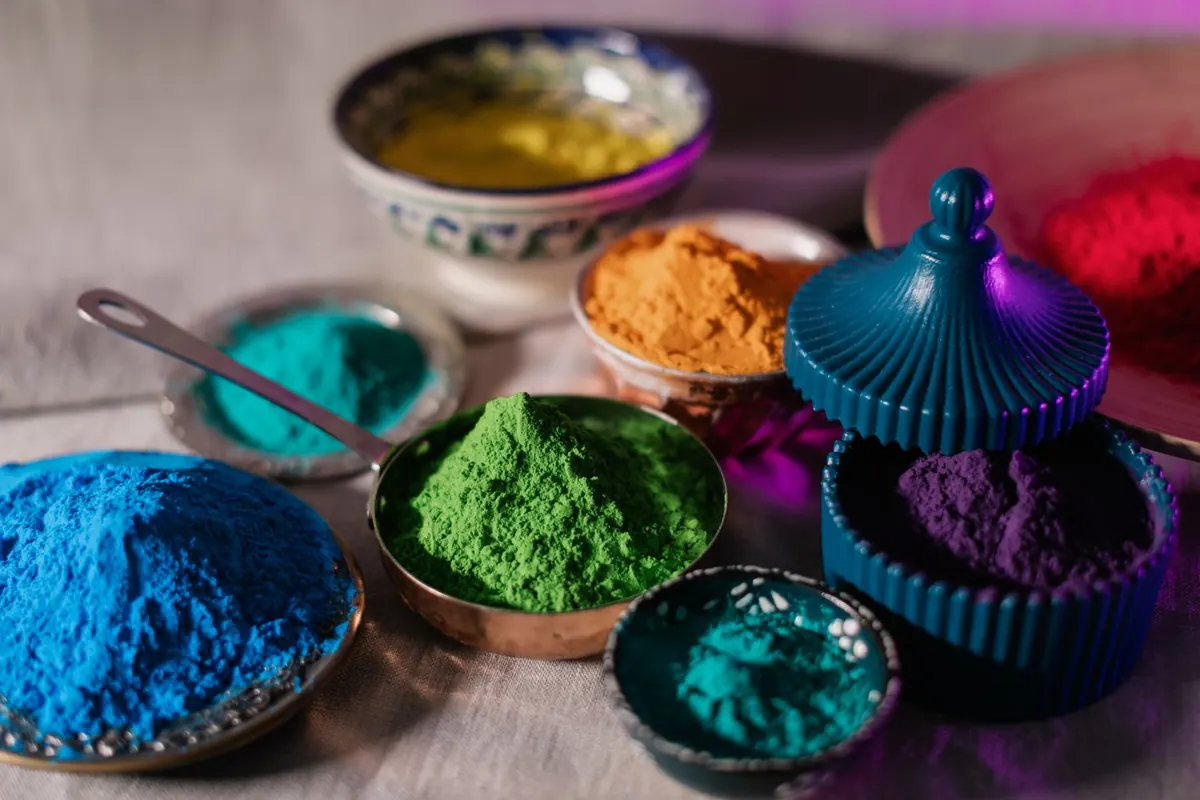
Three blues sit on most dye suppliers' shelves, and they could hardly be less alike. One is a bag of earthy, faintly composty powder that needs coaxing into life. One is a bottle of dark liquid you can use this afternoon. One is a bright synthetic powder that behaves like no indigo you have ever met. They share a name and a colour family, and that is about where the resemblance ends. Which belongs on your bench depends on what you are dyeing, how much patience you have, and the shade you actually want.
That chemistry matters. Vat-dyed indigo sits largely on the surface of the fibre rather than soaking through it, which is exactly why denim fades along the ridges of a twill. Indigo carmine strikes into the fibre more evenly, like any other acid dye, and gives a flatter, cleaner result.
Natural indigo powder always looks expensive by weight, and it varies wildly in strength. Some powders are rich and dark; others are padded with plant matter and need a good deal more in the vat. Add the alkali, the reducing agent, the heat and the hours, and the first dye lot can feel like an investment.
The economics change if you keep the vat alive. A healthy fructose or thiox vat can be topped up and used for weeks, dyeing piece after piece and deepening with each dip. Spread across twenty garments, that bag looks reasonable. Spread across one failed vat, it looks like waste, and many beginners lose their first attempt to temperature or oxygen.
Pre-reduced indigo costs more per bottle but removes the guesswork and one chemical from your shelf. Indigo carmine is the cheapest per gram and goes a long way on wool, but it is close to useless on cotton, so it is poor value if you mostly sew with quilting cloth.
Natural and synthetic indigo are chemically the same dye, so a well-made vat of either should give you a blue you cannot tell apart. In practice, natural indigo often carries a trace of indirubin, which pushes the blue slightly towards purple, and different crops and processing methods give slightly different tones. That variability is either the point or the problem, depending on your temperament.
Both vat dyes build in layers. One dip gives a pale sky; four or five give a deep, near-black navy with the bronze sheen that appears when you rub the cloth. Expect some crocking at first: fresh indigo rubs off onto hands, chairs and lighter fabrics until it has been rinsed and washed a few times.
Indigo carmine is a different animal. It is brighter and cleaner, a primary blue rather than a moody one, and it stops at a medium depth rather than building to navy. It is also widely reported as less lightfast, so it fades on curtains, cushions and anything left in sun. For a scarf or a skein of yarn that lives indoors, that is rarely a problem.
There is no contest here, and it is worth being honest about the learning curve.
Vat dyeing involves caustic soda or lime and a reducing agent that can release sulphur fumes, and both deserve respect: gloves, eye protection, good ventilation, and no leaning over the pot. Read the safety data sheet before you open the packet, store chemicals out of reach of children and pets, and never mix dyes in kitchen equipment you will eat from. If you have asthma, a skin condition or any respiratory sensitivity, take medical advice before working with these materials. Spent baths should be neutralised and disposed of according to your local authority's guidance rather than poured down the drain in quantity.
Natural indigo is a farmed crop. The plants take up land and water, and it takes a great deal of leaf to make a small amount of dye, but the crop is renewable and the waste is largely compostable. Processing methods vary enormously, and some traditional routes use ammonia or lye, so "natural" does not automatically mean gentle.
Synthetic indigo starts life as petrochemical feedstock, and its synthesis is energy-intensive. The bigger issue has historically been the dyehouse: conventional vats use sodium hydrosulphite, which leaves sulphite and sulphate in the wastewater and gives industrial dyeing its distinctive smell. Pre-reduced indigo was developed partly to cut that burden, since the reduction has already been done for you.
Indigo carmine is made by treating synthetic indigo with sulphuric acid, so it carries the same petrochemical origin. It needs no reducing agent, and a well-run bath exhausts reasonably well, but it is still a synthetic dye heading for the wastewater. It is also used as a food colourant and a medical stain, which tells you something about its toxicity profile but nothing about whether it belongs in your drain.
At home, the largest variable is you: how completely you exhaust a bath, how you neutralise it, and whether you dispose of it thoughtfully. Small volumes, diluted and pH-adjusted, are manageable in most places, but check with your water authority rather than assuming.
If you want denim, shibori, layered dips and a blue with depth on cotton or linen, and you are willing to learn to keep a vat alive, natural indigo will reward you. If you want that same look this weekend, or you are teaching a group and need predictable results, pre-reduced synthetic indigo is the practical answer. If you spin, knit or felt, and you want an afternoon's worth of bright blue on wool, silk or nylon, indigo carmine is quick, cheap and easy.
A sensible path for most people is to start with pre-reduced indigo, learn what a good vat looks like and how dipping changes depth, then move to natural indigo once the process is in your hands. Buy small quantities at first, keep a notebook of quantities, temperatures and dip counts, and label every sample with the date. Two years later, that notebook will be worth more than any powder on the shelf.
Photo: Alena Darmel / Pexels